
Select the Installation Location for Outdoor UnitsUpdated 4 months ago
Introduction
This article explains how to select the installation location for outdoor units.
This article is for the following systems:
- Diamante Essenza High-Wall (WYT-17)
- Diamante Pro High-Wall (WYT-20)
- Quantum Fresh High-Wall (WYT-FA)
- Quantum Hyperformance High-Wall (WYT-25)
- Quantum Ultra Ceiling Cassette (CYT-24)
- Quantum Ultra Ducted Ceiling Concealed (RYT-24)
- Quantum Ultra Floor-Ceiling Flex (UYT-24)
- Quantum Ultra High-Wall (WYT-24)
Dimensions
- For the dimensions of the Diamante Essenza High-Wall, click this link.
- For the dimensions of the Diamante Pro High-Wall, click this link.
- For the dimensions of the Quantum Ultra High-Wall, click this link.
- For the dimensions of the Quantum Hyperformance High-Wall, click this link.
- For the dimensions of the Quantum Fresh High-Wall, click this link.
- For the dimensions of the Quantum Ultra Ceiling Cassette, click this link.
- For the dimensions of the Quantum Ultra Ducted Ceiling Concealed, click this link.
- For the dimensions of the Quantum Ultra Floor-Ceiling Flex, click this link.
Select the Location
Follow the tolerances depicted in the illustration below:
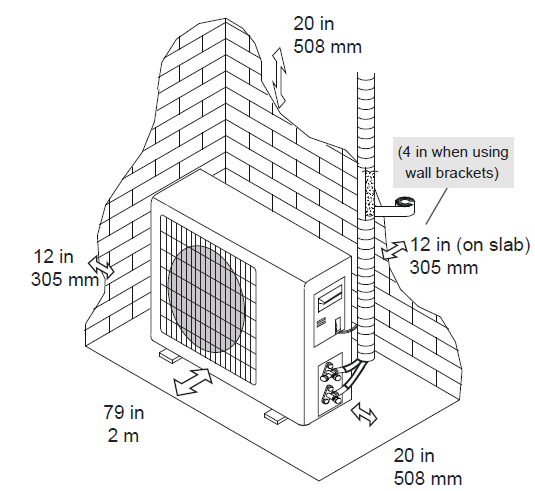
Follow these best practices for selecting the optimal installation location:
- Do not install the unit near sources of heat, steam, or flammable gases.
- Do not install the system in areas prone to extreme winds or dust.
- Do not install the unit in an area that has many individuals pass by.
- Select a location where the air discharge and operating sound level will not disturb others.
- Install the system in a shaded area or utilize cover/sun protection that will not interfere with air flow. This will also protect the system from heavy rain or snow.
- Install the unit in a safe and sturdy location.
- Install rubber vibration absorbers if the system can induce vibrations in any structure.
- If the unit is exposed to heavy wind: Install the unit so that the air outlet fan is at a 90° angle to the direction of the wind. If needed, use wind baffles or build a barrier in front of, but sufficiently away from, the unit to protect it from extremely heavy winds.
- If the unit is frequently exposed to heavy rain or snow: Build a shelter above the unit to protect it from the rain or snow. Be careful not to obstruct the air flow around the unit.
- If the unit is frequently exposed to salty air (seaside air): Use specifically approved anti-corrosion coating sprays on the heat exchanger surface in order to resist corrosion.