
Connect the Refrigerant PipingUpdated a month ago
Introduction
This article explains how to connect refrigerant piping to indoor and outdoor units for all systems. It also includes specific piping specifications for each model.
Notes
- Insulate the refrigerant piping. All refrigerant piping from Pioneer arrives pre-insulated. While Pioneer piping comes pre-insulated, installers must still insulate the joints after evacuating the refrigerant circuit.
- The length of the refrigerant piping will affect the performance and energy efficiency of the unit.
- Nominal efficiency is tested on units with a pipe length of 16 feet (4.9 m)
- The factory precharge supports up to 25 feet (7.6 m) of connected lineset.
- The total piping length should not be less than 10 feet (3 m).
- If the factory precharge is modified, make a note of the charge modification amount.
Refrigerant Piping Specifications
For information on refrigerant piping specifications for different systems, click this link.
Prerequisites
- Do not install the piping until both the indoor and outdoor units have been installed.
1. Plan the Piping Layout
Before beginning the installation, plan the refrigerant piping layout and connection.
Oil Traps
If oil flows back into the outdoor unit's compressor, this might cause liquid compression or deterioration of the oil return. Oil traps in the rising gas piping can prevent this.
Outdoor Unit is Beneath the Indoor Unit
Install an oil return bend every 19-feet, 8-1/4-inches (6 m). There is no need to add a non-return bend at the lowest and highest positions of the vertical pipe. 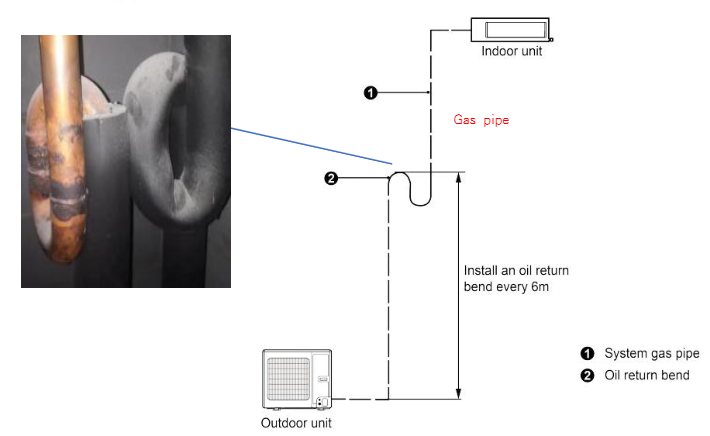
Outdoor Unit is Above the Indoor Unit
Install an oil return bend every 19-feet, 8-1/4-inches (6 m). Add the oil return bend and non-return bend at the lowest and highest positions of the vertical pipe.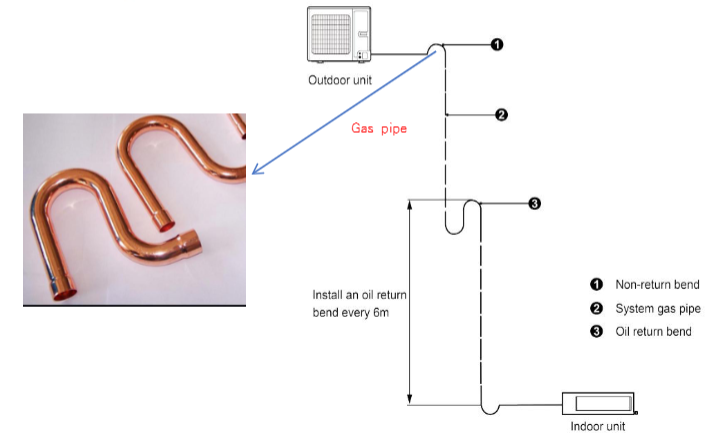
Oil Trap Dimensions
The dimensions for creating the oil return bend are as follows:
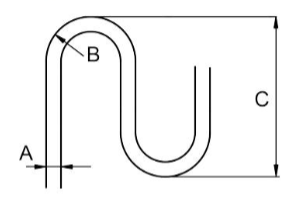
| A | B | C |
| Ø 3/8 in | ≥ 3/4 in (20 mm) | ≤ 5-7/8 in (150 mm) |
| Ø 1/2 in | ≥ 1 in (26 mm) | ≤ 5-7/8 in (150 mm) |
| Ø 5/8 in | ≥ 1-1/4 in (33 mm) | ≤ 5-7/8 in (150 mm) |
2. Unwind the Piping
Unwind the refrigerant piping gently against a flat surface, rather than pulling at the ends. 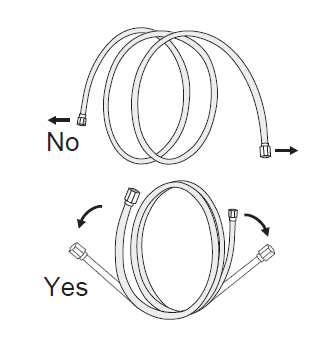
- Do not remove the seal caps from the pipe ends until it is time to connect it, avoiding contaminants from entering.
- Do not bend the pipe more than three times at one point. Be extremely careful not to kink the piping.
- When bending refrigerant piping, the minimum bending radius is 4 inches (102 mm).
3. Adjust the Piping Length (Optional; If Needed)
If needed, precisely cut the refrigerant pipes to the appropriate length to meet the installation requirements. This guarantees efficient operation and minimizes future maintenance.
Next, remove the burrs from the piping after cutting. This maintains an airtight seal on the refrigerant connections.
Once the piping is cut and the burrs are removed, flare the pipe ends. Proper flaring is essential to achieve an airtight seal. If pre-flared refrigerant piping arrives damaged, it can be re-flared.
Cut the Pipes
Note: Be careful not to damage, dent, or deform the pipe while cutting. This will drastically reduce the heating efficiency.
1. Measure the distance between the indoor and outdoor units.
2. Use a pipe cutter to cut the pipe a little longer than the measured distance.
3. Make sure the pipe is cut at a perfect 90-degree angle. 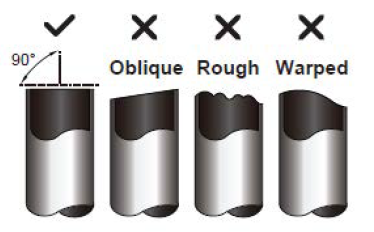
Remove Burrs
1. Hold the pipe at a downward angle to prevent burrs from falling into the pipe.
2. Use a reamer or deburring tool to remove all the burrs from the cut section of the pipe.
Flare Pipe Ends
1. Seal the pipe ends with PVC tape to prevent foreign materials from entering.
2. Confirm that the pipe was sheath properly with insulation material.
3. Place the flare nuts on both ends of the pipe. Make sure they are facing the correct direction, because it is not possible to change their direction after flaring.
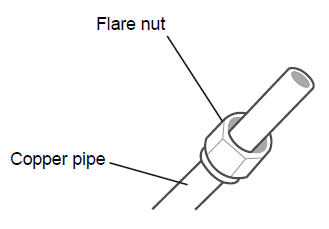
4. Remove the PVC tape from the ends of the pipe when ready to perform the flaring work.
5. Clamp the flare form on the end of the pipe. 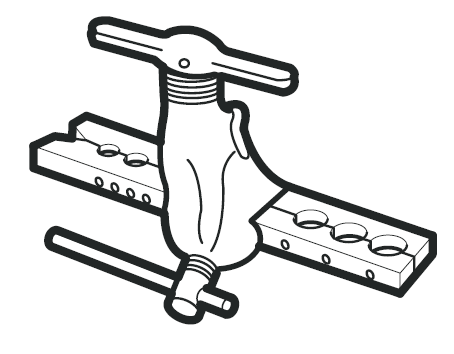
The end of the pipe must extend beyond the edge of the flare form in accordance with the dimensions shown in the tables:
Piping Extension Beyond Flare Form
| Pipe Diameter | Flare Dimension A | Flare Shape | |
| Min. | Max. | ||
| Ø 1/4 in / Ø 6.35 mm | 0.33 in / 8.4 mm | 0.34 in / 8.7 mm | 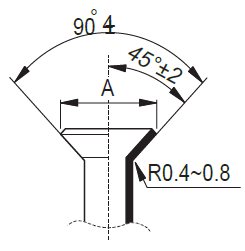 |
| Ø 3/8 in / Ø 9.52 mm | 0.52 in / 13.2 mm | 0.53 in / 13.5 mm | |
| Ø 1/2 in / Ø 12.7 mm | 0.64 in / 16.2 mm | 0.65 in / 16.5 mm | |
| Ø 5/8 in / Ø 15.9 mm | 0.76 in / 19.2 mm | 0.78 in / 19.7 mm | |
| Ø 3/4 in / Ø 19 mm | 0.91 in / 23.2 mm | 0.93 in / 23.7 mm | |
| Ø 7/4 in / Ø 22 mm | 1.04 in / 26.4 mm | 1.06 in / 26.9 mm | |
| Pipe Diameter | Torque N.m (lb.ft) | Sketch Map |
| Ø 1/4 in / Ø 6.35 mm | 18~20 (13.3~14.8) | 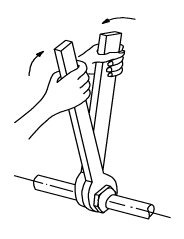 |
| Ø 3/8 in / Ø 9.52 mm | 32~39 (23.6~28.8) | |
| Ø 1/2 in / Ø 12.7 mm | 49~59 (36.1~43.5) | |
| Ø 5/8 in / Ø 15.9 mm | 57~71 (42~52.4) | |
| Ø 3/4 in / Ø 19 mm | 67~101 (49.4~74.5) | |
| Ø 7/4 in / Ø 22 mm | 85~110 (62.7~81.1) |
6. Place the flaring tool onto the form.
7. Turn the flaring tool's handle clockwise until the pipe is fully flared.
8. Remove the flaring tool and flare form, then inspect the end of the pipe for cracks and flaring.
4. Connect the Pipes
Connect the copper pipes to the indoor unit first, then connect it to the outdoor unit. Connect the low-pressure pipe, then the high-pressure pipe. Use both a spanner and torque wrench when connecting or disconnecting pipes to the unit.
Once the copper piping kit is unwound, refer to the instructions below.
Indoor Unit
1. Bring the ends of both the copper line and the indoor line together. Align the centers of the pipes that will be connected. 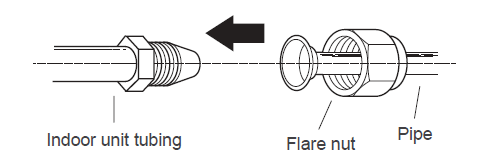
2. Remove the indoor unit piping cap and check that no debris is inside. Some gas may be heard escaping, but it is dry nitrogen to keep the lines clean.
3. Use any available leak guard or flare sealer on the piping flares. 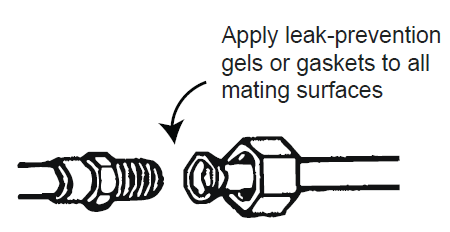
4. Attach the flare nut and tighten as much as possible by hand. 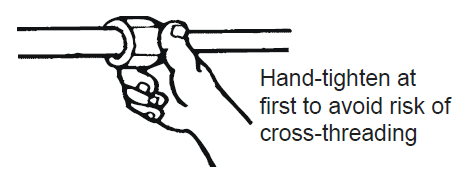
Torque correctly to the specifications found in the table below using two wrenches. Excessive force can break the flare nut or damage the refrigerant piping. Do not exceed the torque requirements.
Tightening Torque for Protection Caps & Flange Connection
| Pipe Diameter | Tightening Torque [N x m] | Tightening Torque [ft-lbf] | Corresponding Stress (Using a 20 cm Wrench) |
| Ø 1/4 in / Ø 6.35 mm | 15 - 20 | 11 - 15 | Wrist Strength |
| Ø 3/8 in / Ø 9.52 mm | 31 - 35 | 23 - 26 | Arm Strength |
| Ø 1/2 in / Ø 12.7 mm | 45 - 50 | 33 - 37 | Arm Strength |
| Ø 5/8 in / Ø 15.9 mm | 60 - 65 | 44 - 48 | Arm Strength |
| Tightening Torque [N x m] (ft-lbf) | |
| Service Port Nut | [7 - 9] (5-7) |
| Protection Caps | [25 - 30] (18-22) |
5. Repeat the process for the other copper line.
6. After connecting copper lines to the indoor unit, wrap the power cable, signal cable, and piping together with binding tape. When bundling these items, do not intertwine or cross the signal cable with any other wiring.
7. Thread this pipeline through the wall and connect it to the outdoor unit. The next section explains how to connect the pipes to the outdoor unit.
8. Optional: Attach the water receiver (supplied in the accessories box) to the indoor unit using a screw.
Outdoor Unit
1. Unscrew the cover from the packed valve side of the outdoor unit.
2. Remove the protective caps from the valve ends.
3. Align the flared pipe end with each valve and tighten the flare nut as tightly as possible by hand.
4. Use a spanner to grab the body of the valve. Do not grab the nut that seals the service valve. 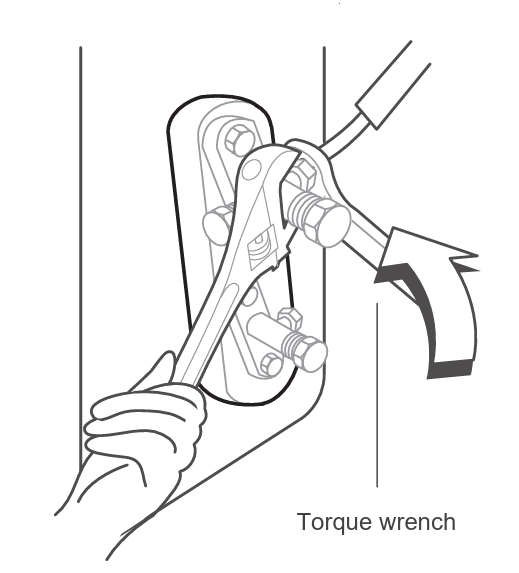
5. While firmly gripping the body of the valve, use a torque wrench to tighten the flare nut according to the correct torque values.
6. Loosen the flaring nut slightly, then tighten again.
7. Repeat the process for the remaining pipe.
8. Open the stop valves of the outdoor unit to start the flow of the refrigerant. 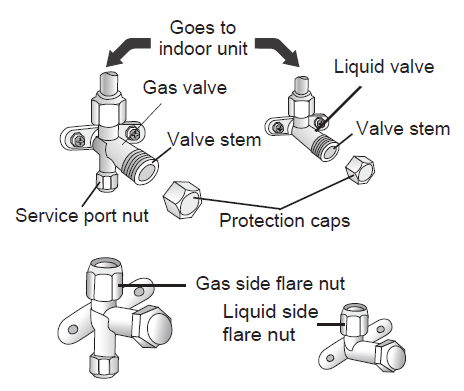
After completing the refrigerant piping connection, check for refrigerant leaks. If a leak is detected, ventilate the area immediately and evacuate the system.
5. Charge Additional Refrigerant (If Needed)
Some systems require additional charging depending on the pipe lengths. In North America, the standard pipe length is 25 feet (7.5 m). Do not mix different types of refrigerant.
Charge the refrigerant from the service port on the outdoor unit's low-pressure valve.
6. Insulate the Refrigerant Piping Joints
Only insulate the refrigerant piping joints after the refrigerant circuit has been properly evacuated.
The pipe joint insulation should be 2~4 inches (51~102 mm) longer than the gap to ensure a proper seal.
Insert the pipe joint insulation into the gap of the existing insulation.
Ensure the pipe joint insulation is securely fastened to the suction and liquid pipes to prevent gaps. Use glue to paste together the linking part. Do not over-tighten the insulation material. This may compress the air out of the material, causing poor insulation and early aging.