
Understand the Best Duct Selection Practices for Ducted Ceiling Concealed Indoor UnitsUpdated 2 months ago
Introduction
This article explains the best duct selection practices for ducted ceiling concealed indoor units.
This article is for the following system:
Quantum Ultra Ducted Ceiling Concealed (RYT-24)
Outlet Duct Connection Guidelines
This indoor unit supports both rectangular and round duct connections. We do not have specific ducting recommendations as each project and scenario are different. However, follow the instructions below to ensure proper airflow and system performance.
Rectangular Ducting
Connect the rectangular air ducts directly to the indoor unit's discharge outlet using rivets or other secure fastening methods. 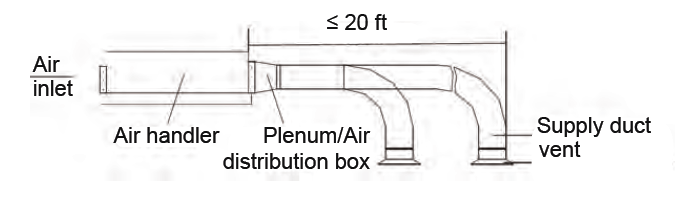
Round Ducting
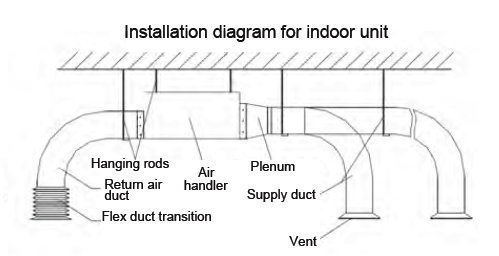
Connect the round ducts using a transition adapter between the round duct and the unit's rectangular outlet. The outlet can then branch to one or more supply air grilles or air outlet windows as needed.
Important Notes
- Use airflow diverters or branch dampers to balance the airflow to multiple outlet grilles, if needed.
- Ensure that the air velocity at each outlet is consistent in order to maintain uniform comfort throughout the conditioned space.
- Always comply with local building codes and ducting best practices when routing and insulating ducts.
Return Air Duct Installation
The indoor unit comes pre-configured for downward air return, but can be modified for rear (backward) air return operation if needed. For information on configuring the indoor unit for rear air return operation, click this link.
Use the following procedures for proper installation.
Downward (Underside) Return Configuration
Use a section of pleated canvas duct as a flexible connection between the unit's return air opening and return air grille. Secure the duct to the unit and grille using rivets or suitable fasteners. 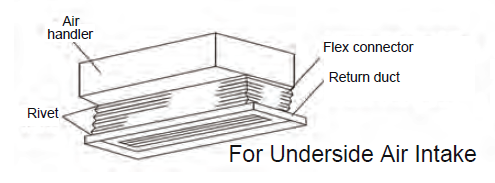
The flexible canvas connection allows for adjustment based on the ceiling height. In addition, the connection helps absorb vibration, reduce noise, and prevent ceiling panel movement during operation.
Rear (Sideways) Return Configuration
Fabricate or obtain a rigid return air duct, then connect it securely to the unit's return air opening using rivets. 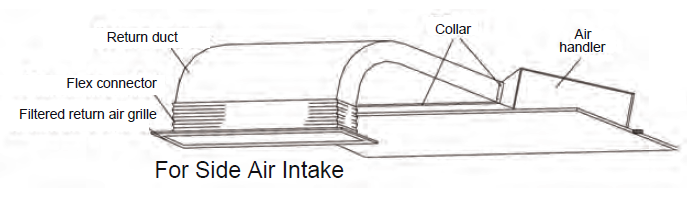
Connect the opposite end of the duct to the return grille or air return window.
A duct flex connector is recommended at the grille end to allow slight movement and provide noise isolation.
Note: Regardless of the configuration, always ensure that all connections are airtight and structurally supported to avoid air leakage, vibration, and noise during operation.