
Evacuate the Refrigerant CircuitUpdated 7 minutes ago
Introduction
This article explains how to evacuate the air conditioner's refrigerant circuit.
Air and foreign matter in the refrigerant circuit can lead to abnormal rises in pressure, which can damage the appliance, reduce its efficiency, and cause injury.
Use a vacuum pump and manifold gauge to evacuate the refrigerant circuit, removing any non-condensable gas and moisture from the system.
Perform the evacuation after the initial installation and when relocating the system.
Prerequisites
- Confirm the pipes connecting the indoor and outdoor units are properly attached.
- Ensure all electrical wiring is connected properly.
Steps
1. Remove the caps from the 2-way and 3-way valves, but do not manipulate the valves until step 11. 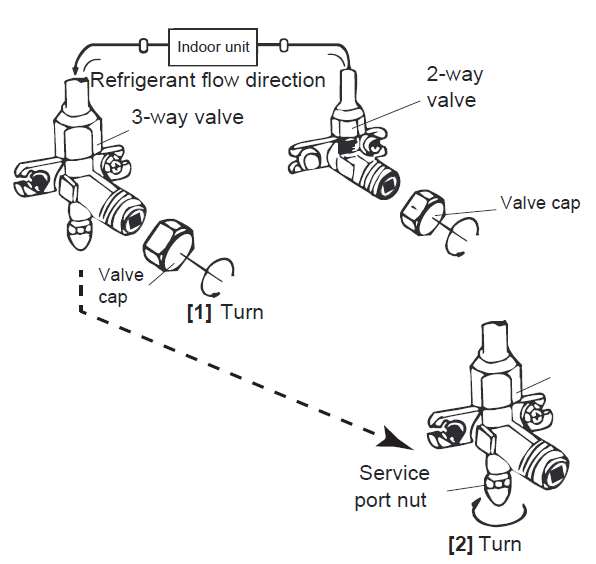
2. Unscrew and remove the cap from the service port.
3. Connect the manifold gauge's charge hose to the service port of the outdoor unit's low-pressure valve.
4. Connect another charge hose from the manifold gauge to the vacuum pump.
5. Open the manifold gauge's low-pressure side. Keep the high-pressure side closed.
6. Turn on the vacuum pump to evacuate the system.
7. Run the vacuum for at least 15 minutes or until the compound meter reads -76cmHG. 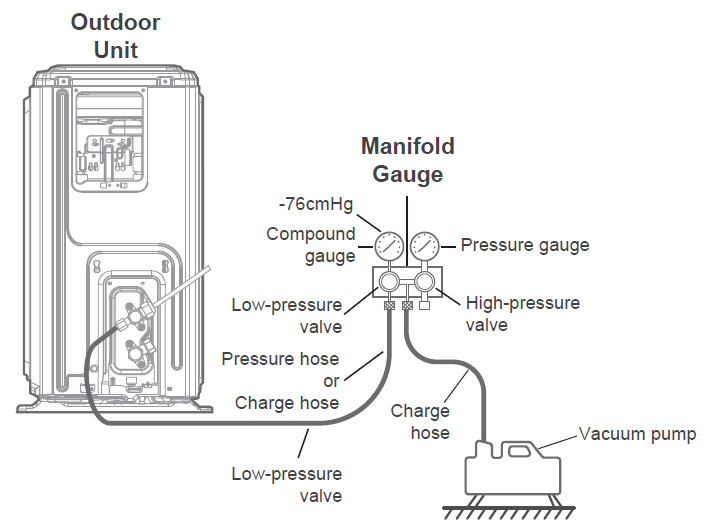
8. Close the manifold gauge's low-pressure side, then turn off the vacuum pump.
9. Wait 5 minutes, then confirm there has been no change in system pressure.
10. If system pressure changes, check for leaks. If it remains stable, unscrew the cap from the high-pressure (packed) valve.
11. Insert a hexagonal wrench into the high-pressure (packed) valve and open it by turning the wrench 1/4 turn counterclockwise. Listen for gas exiting, then close the valve after 5 seconds.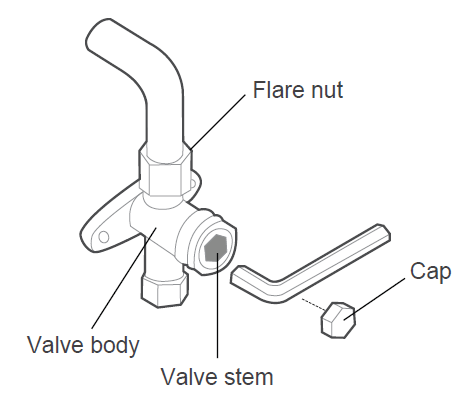
12. Watch the pressure gauge for 1 minute to ensure there is no change in pressure. The pressure gauge should read slightly higher than the atmospheric pressure.
13. Remove the charge hose from the service port.
14. Use a hexagonal wrench to fully open the high-pressure and low-pressure valves.
15. Hand-tighten the caps on all three valves: the service port, high-pressure, and low-pressure. Then, use a torque wrench to tighten them to specification.